






**Harnessing Artificial Intelligence for Sustainable Materials and Circular Economies**
The rapid advancement of technology in the modern world has paved the way for groundbreaking innovations in various fields. Among these, artificial intelligence (AI) is emerging as a pivotal force driving the shift towards more sustainable materials and circular economies. As our global society grapples with environmental challenges such as resource depletion and waste management, AI offers powerful tools to develop solutions that promote sustainability and efficiency.
**The Role of AI in Sustainability**
At its core, AI refers to the ability of machines to perform tasks that typically require human intelligence. This includes capabilities like learning, reasoning, and problem-solving. In the realm of materials research, AI is setting the stage for more sustainable practices by enabling the design, usage, and recycling of materials in a way that minimizes waste and maximizes resource efficiency.
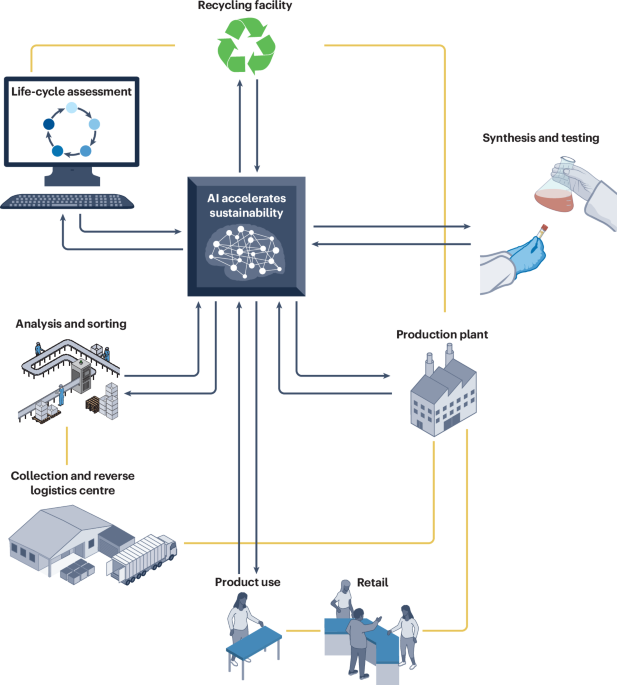
Traditional industrial processes often follow a linear path: raw materials are extracted, products are manufactured and used, and eventually discarded as waste. This approach is neither sustainable nor efficient, as it strains environmental resources and leads to significant waste generation. AI, however, facilitates a closed-loop, or circular, material economy by integrating performance evaluations, life cycle assessments, and sustainability metrics throughout the various stages of a material’s life.
**AI-Driven Innovation in Materials Design**
One of the most promising aspects of AI in materials science is its ability to accelerate the discovery and optimization of new materials. By utilizing machine learning algorithms, AI can analyze vast data sets to identify materials with desired properties for specific applications. This capability is particularly valuable in sectors such as energy, catalysis, and polymer production.
For example, AI can aid in finding all-natural substitutes for traditional plastics, which are notorious for their environmental impact due to their non-biodegradable nature. By predicting the structure-property relationships of different substances, AI can suggest innovative materials that fulfill functional requirements while also being sustainable and eco-friendly.
**Promoting Resource Efficiency through Closed-Loop Systems**
AI’s contribution to sustainability is not limited to the creation of new materials; it also enhances the overall resource efficiency of existing processes. By shifting from linear to circular material systems, resources are not only used sparingly, but also kept in use for as long as possible. This translates into significant reductions in waste and an increase in the recyclability of materials.
In practice, AI can optimize recycling processes by identifying the most efficient methods for breaking down complex materials into reusable components. Additionally, AI can monitor the ongoing performance of materials in use, predicting when they will need maintenance or replacement to prolong their functional lives. These improvements streamline the entire material lifecycle, reducing environmental impact and fostering sustainability.
**Key Takeaways: Towards a Sustainable Future**
As AI continues to evolve, its role in fostering more sustainable material systems becomes increasingly critical. By facilitating the transition from traditional linear processes to circular economies, AI not only propels resource efficiency but also minimizes environmental impact. Through its capabilities in discovering and optimizing materials, AI supports eco-design initiatives and the creation of novel substances geared towards sustainability.
In conclusion, artificial intelligence holds substantial potential to drive transformative change in the domain of materials science. By embracing AI’s promise and applying its powerful tools to develop sustainable materials and processes, we take significant strides towards a more sustainable and resource-efficient future. As industries look to mitigate their environmental impacts, AI stands ready to support and accelerate this vital transition.
AI for sustainable materials and circularity
https://www.nature.com/articles/s41578-026-00912-8