
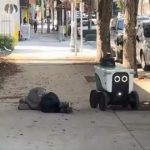





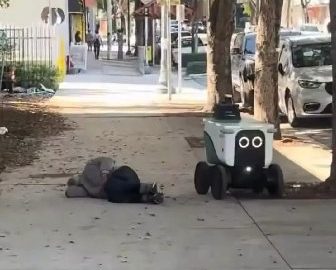
In a world increasingly shaped by algorithms and automation, moments of stark juxtaposition can offer profound insights into our present and future. One such moment, captured in an urban snapshot, features a small, autonomous delivery robot navigating a paved sidewalk, its sensors whirring, as it glides past a person lying on the ground, wrapped in coverings. This scene, set against a backdrop of trees and parked vehicles on a typical city street, is more than just a picture; it’s a powerful allegory for the complex challenges and ethical questions posed by our accelerating technological progress.
### The Automated Vanguard on Our Streets
The star of this particular segment of urban automation is the autonomous delivery robot. With its compact design, wheels, and an array of sensors, it represents the cutting edge of “last-mile” logistics. These sidewalk delivery bots are engineered for efficiency, designed to bridge the final gap between a distribution hub and the customer’s doorstep – a crucial and often costly part of the supply chain for food and groceries.
Companies like Starship Technologies are at the forefront of this revolution, deploying fleets of these robots in various UK cities and beyond. Their promise is compelling: faster, cheaper, and more environmentally friendly deliveries. They operate autonomously, following predetermined routes, avoiding obstacles, and even crossing roads, all thanks to sophisticated AI and real-time mapping. For businesses, they offer reduced labor costs and increased delivery capacity. For consumers, they provide unparalleled convenience, bringing goods directly to their homes with minimal human intervention. This vision of seamless, automated service is quickly becoming a tangible reality in urban centers worldwide.
### The Uncomfortable Juxtaposition
Yet, the significance of our urban scene lies not just in the robot itself, but in its silent interaction with the human element. The person lying on the ground, wrapped in coverings, immediately evokes a sense of vulnerability and need. While the robot is programmed to identify and navigate around obstacles, its primary function is transactional – to complete a delivery. Its sensors register the person as a static object to be avoided, not a human being potentially in distress.
This stark contrast between advanced technology on a mission of convenience and a visible human reality of possible hardship creates a profound, if uncomfortable, paradox. The robot, a symbol of progress and efficiency, moves with programmed purpose, seemingly oblivious to the immediate human condition it encounters. It’s not a critique of the robot’s design, which is fundamentally functional, but rather a prompt to examine the societal landscape in which these technologies are deployed.
### Beyond Code: Ethical Questions and Societal Reflections
This scene compels us to look beyond the immediate algorithms and consider the broader ethical and societal implications of automation. When we design and integrate autonomous systems into public spaces, what values are we inadvertently prioritizing? Is the drive for efficiency and convenience overshadowing a collective awareness of human vulnerability?
The “programmed indifference” of the robot, while purely a function of its operational parameters, serves as a powerful metaphor for potential blind spots in our societal development. As technology advances, there’s a growing risk that it might exacerbate existing social divides, creating a world of enhanced services for some, while others become increasingly marginalized, even invisible, to the automated systems that now govern parts of our daily lives.
This isn’t to say that robots *should* be programmed to intervene in human crises, which opens an entirely new Pandora’s box of ethical and practical challenges. Instead, it prompts a deeper question: How do we, as a society, ensure that the benefits of technological progress are equitably distributed, and that our technological advancements don’t inadvertently dehumanize or ignore those who are most in need? It forces us to confront whether the pursuit of technological Utopia might inadvertently widen the gap between the haves and have-nots, creating urban environments where efficient machines seamlessly serve a segment of the population, while others struggle for basic survival.
### The Changing Urban Fabric and the Path Forward
The integration of autonomous vehicles and robots is fundamentally reshaping our urban fabric. Sidewalks, once solely the domain of pedestrians, are now shared spaces where human and machine trajectories intersect. This necessitates a holistic approach to urban planning and technological deployment – one that doesn’t just focus on technical feasibility but also on social integration and ethical responsibility.
This scene challenges us to consider what kind of future we are building. Can we design smart cities that are not just efficient but also empathetic? Can autonomous systems be part of a solution to social problems, rather than merely existing alongside them? Perhaps, the next frontier in AI development isn’t just about faster navigation or more efficient deliveries, but about embedding a broader societal awareness into the very fabric of our automated world. This could involve using the data collected by these systems to identify areas of need, or ensuring that a portion of the efficiency gains from automation are reinvested into social support systems.
### Conclusion
The urban scene of a robot, a person, and the implicit force of automation is a powerful snapshot of our times. It highlights the dazzling pace of technological advancement and the promise of a more convenient future. But more critically, it serves as a crucial reminder that technology is not developed in a vacuum. It interacts with existing social realities, often exposing the fault lines within our communities.
As we continue to embrace automation and integrate it deeper into our cities, the challenge is clear: we must not only innovate with technical prowess but also with profound social consciousness. The true measure of our progress will not just be in how efficiently our robots deliver groceries, but in how effectively we address the human realities that unfold on the same sidewalks, ensuring that the automated future is inclusive, empathetic, and serves the well-being of all its inhabitants. This scene is not just an observation; it is an urgent call for reflection and responsible design.