







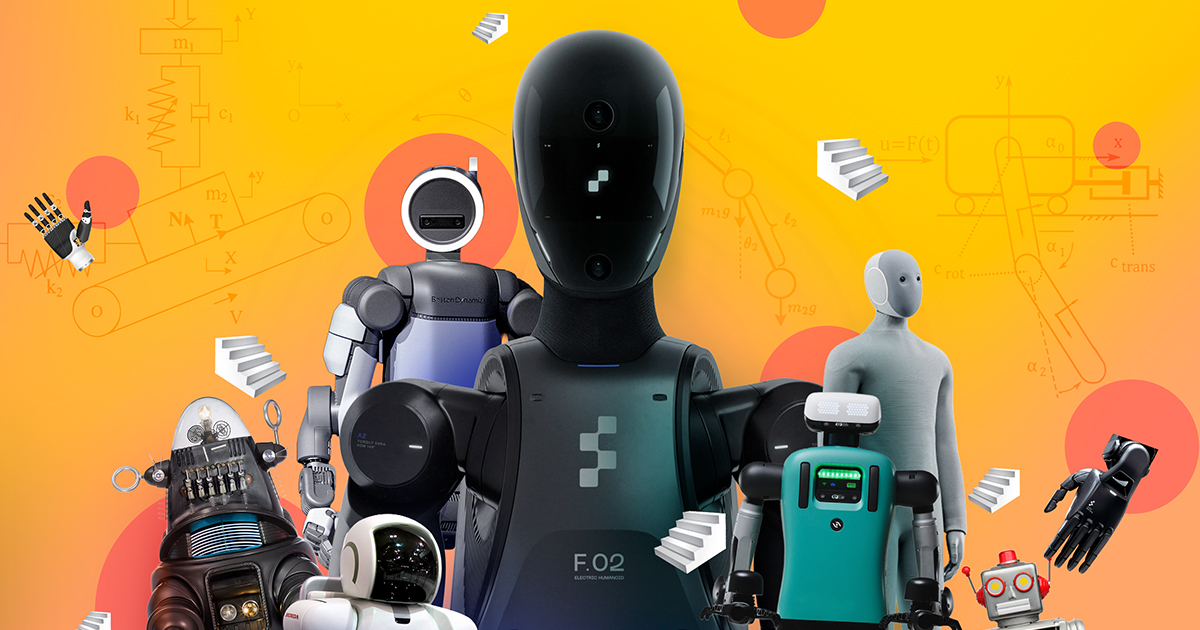
Recent advancements in humanoid robotics have created the perception of a paradigm shift, with companies promoting a future populated by sophisticated androids capable of complex maneuvers. While demonstrations showcase robots performing intricate tasks like breakdancing or handling irregular items, a closer look reveals that even leading models still struggle with basic real-world challenges such as reliably navigating stairs or opening doors. Experts in the field acknowledge that these seemingly simple tasks remain largely unsolved for their flagship robots.
This apparent paradox stems from a series of significant technological leaps over the last decade. First, deep learning, leveraging neural networks and fast GPU chips, dramatically enhanced computer vision and reinforcement learning. This allowed robots to perceive and interact with their environments with unprecedented speed and sophistication. Second, around 2016, an actuation revolution replaced heavy hydraulic systems with smaller, “proprioceptive” electric motors. These motors imparted animal-like nimbleness and crucial compliance, enabling robots to absorb impacts and adapt to real-world disturbances without sustaining damage. This compliant hardware was a key enabler for the practical application of reinforcement learning. Lastly, the adaptation of large language models for robotics, leading to vision-language-action (VLA) models, has empowered robots to plan and execute multistep tasks autonomously based on natural language commands and visual input, unifying previously disparate approaches to robotic perception, planning, and control.
These three advancements collectively transformed humanoid robotics. Deep reinforcement learning now allows robots to learn “whole-body control” policies through countless digital simulations, coordinating movement, balance, and collision avoidance without the need for hand-engineered algorithms or simplified physics models. The compliant actuators, pioneered by researchers like Sangbae Kim, made it possible for robots to learn and recover from errors in the real world, which was previously prohibitive due to frequent hardware damage. VLA models, exemplified by Google DeepMind’s work, allow robots to interpret commands like “I’m thirsty” and autonomously generate the necessary physical steps, from finding a cup to picking it up.
Despite these profound developments, which have led to robust physical embodiment and a foundational level of generalizable intelligence, humanoids are not yet considered “solved” even in principle. The ongoing difficulty with reliable execution of common, small-scale interactions in unstructured environments suggests a deeper challenge remains in bridging the gap between impressive demonstrations and consistent, practical utility in everyday settings.
Why Do Humanoid Robots Still Struggle With the Small Stuff?